





Are you struggling to keep up with the breakneck speed of digital innovation? Many readers feel overwhelmed by fragmented updates and hype-driven headlines that lack real-world context. At techslassh.com – future of technology, we cut through the noise to provide a clear, evidence-based roadmap of the trends that actually matter for your life and career this year.
The Evolution of AI: Moving Beyond Experimentation
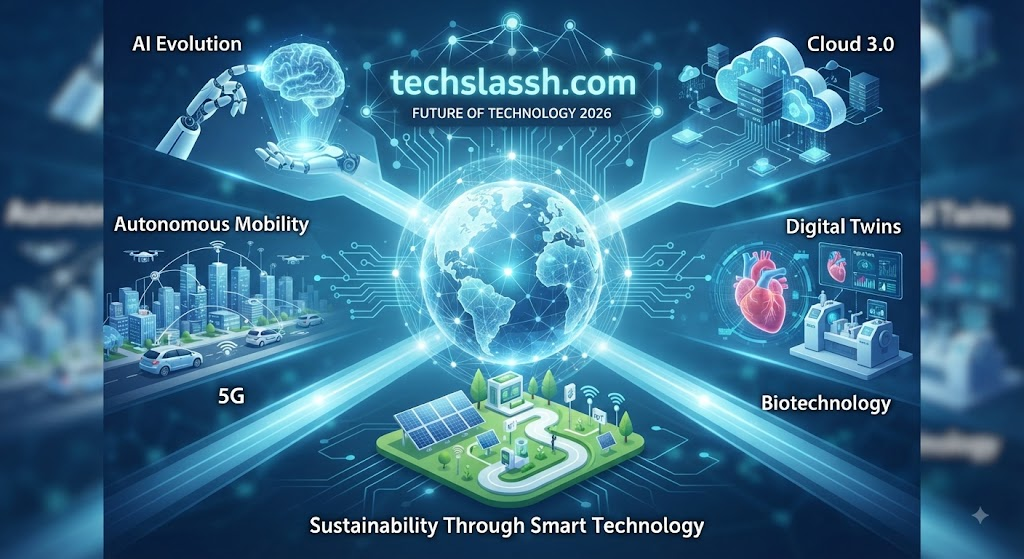
Artificial Intelligence has officially transitioned from a novelty to an essential utility. In 2026, we see a shift toward “Agentic AI,” where systems don’t just generate text but autonomously execute complex workflows.
Organizations now treat AI as the backbone of their infrastructure rather than a standalone tool. This maturity ensures that AI models provide more reliable, secure, and context-aware results for daily users.
Cloud 3.0: The Backbone of Digital Architecture
Cloud computing has entered a new phase known as Cloud 3.0. Unlike previous versions focused solely on storage and cost-saving, this iteration powers AI-driven applications and real-time data processing.
- Hybrid Models: Businesses increasingly combine private and public clouds for better security.
- Sovereign Clouds: Data residency laws drive the adoption of region-specific cloud storage.
- Edge Integration: Processing data closer to the user reduces latency for smart devices.
The Rise of Intelligent Operations
When exploring techslassh.com – future of technology updates, you will notice a trend toward “Intelligent Ops.” Enterprises are replacing rigid, manual processes with modular ecosystems that self-correct and learn. By blending human oversight with autonomous agents, companies achieve higher resilience and agility in shifting markets.
5G Expansion and Ubiquitous Connectivity
The full promise of 5G is finally reaching maturity in 2026. With ultra-low latency and massive device capacity, this network foundation enables innovations that were previously impossible, such as seamless remote surgery and high-definition immersive learning.
Autonomous Mobility: Reshaping Our Cities
Self-driving technology has moved past passenger cars into logistics and public transit. By 2026, autonomous delivery bots and fleet-managed transportation systems are becoming common sights in urban centers, significantly lowering operational costs and improving traffic flow.
Advanced Robotics and Human Collaboration
Robots are no longer confined to factory floors. Today, collaborative robots—or “cobots”—work alongside humans in healthcare, hospitality, and retail. These machines use advanced sensors and machine vision to adapt to unpredictable environments safely.
Digital Twins in Industry and Healthcare
A Digital Twin creates a virtual replica of a physical asset, allowing for real-time monitoring and predictive maintenance.
- Manufacturing: Prevents equipment failure before it happens.
- Healthcare: Maps patient data to simulate treatment outcomes safely.
Cybersecurity in the Age of AI
As AI evolves, so do cyber threats. The industry now prioritizes “Zero Trust” architectures and AI-powered threat detection that closes vulnerabilities in real time. Protecting data assets has become a fundamental business requirement rather than an IT afterthought.
Sustainability Through Smart Technology
Green tech is no longer just a trend; it is a measurable necessity. Companies use IoT sensors and AI analytics to track carbon footprints, optimize energy consumption in smart buildings, and reduce waste across supply chains.
Biotechnology and Personalized Medicine
The intersection of data science and biology is revolutionizing health. We now see tailored treatment plans based on genetic markers and wearable health monitors that provide doctors with continuous, accurate patient data.
Comparison of Key Technology Trends 2026
| Technology | Primary Benefit | Industry Impact |
| Agentic AI | Autonomous Task Completion | Software Development, Admin |
| Cloud 3.0 | AI-Ready Infrastructure | Enterprise Operations |
| Digital Twins | Predictive Maintenance | Manufacturing, Healthcare |
| 5G Networks | Ultra-Low Latency | Logistics, Telemedicine |
Frequently Asked Questions
What is the primary focus of techslassh.com – future of technology?
It provides curated insights into emerging digital trends, helping users understand how AI, cloud computing, and automation impact daily life and business.
Why is 2026 considered the “Year of Truth” for AI?
It marks the shift from hype and experimentation to measurable enterprise-wide adoption and trusted, governed AI value systems.
How do Digital Twins work?
They create a virtual model of a physical object or process, using real-time data to simulate performance and improve decision-making.
Is 5G necessary for future technology growth?
Yes, 5G provides the high-speed, low-latency connectivity required for IoT, autonomous vehicles, and remote operational technologies.
What is Cloud 3.0?
It is the next evolution of cloud computing, acting as the operational foundation for AI-driven architectures and secure data handling.
How can I stay updated on tech trends?
Following reliable resources like techslassh.com – future of technology helps you track vetted information rather than transient industry buzz.
Final Thoughts
Staying informed on the techslassh.com – future of technology landscape is vital for professional growth in 2026. The shift toward autonomous, AI-integrated systems offers massive potential for those ready to adapt. Start by exploring one of these areas today—whether it’s learning basic AI prompting or understanding cloud security—to ensure you remain competitive in an increasingly digital economy.
Sources: Capgemini, Esade, Henry Harvin
You Main Also Read More : techslassh.com – future of technology